Mendoza's Three Wine Regions, Compared
Maipú vs Luján de Cuyo vs the Uco Valley: distance, altitude, price, wine style and which one to give your day to. The comparison the tour listings skip.
Mendoza is not one wine region, it is three, and the tour listings mostly do not explain the difference — they just quote a price. Since the difference is the main thing that sets the price, that is a problem worth fixing before you book.
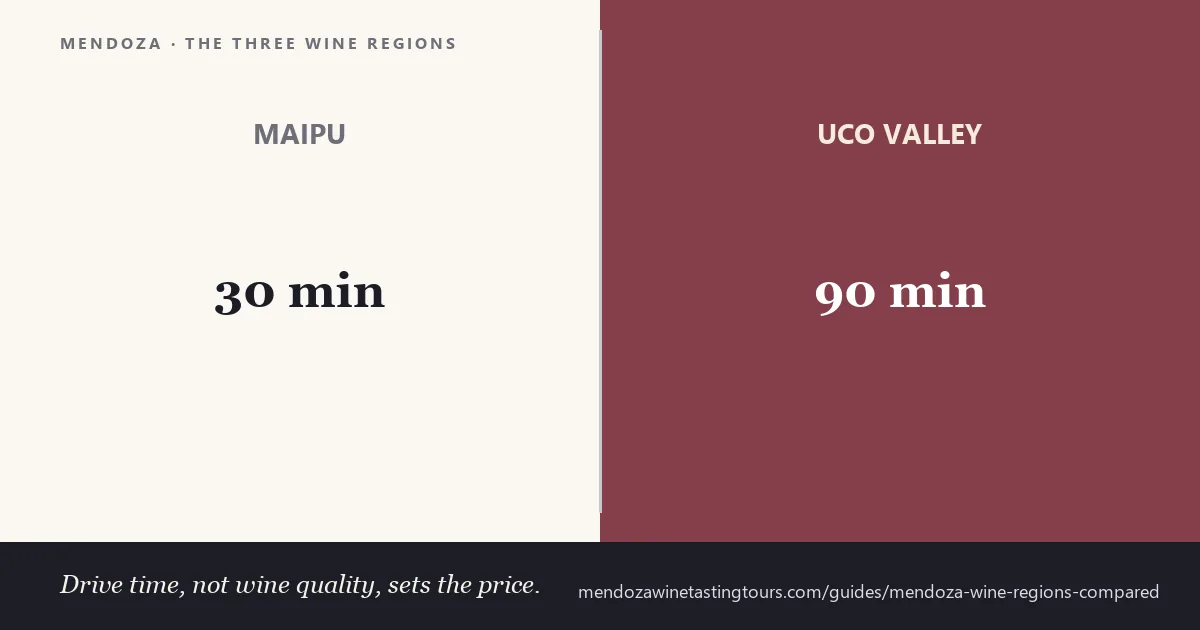
Here is each district on the four things that actually matter: how far it is, how high it is, what it costs, and what the wine tastes like when you get there.
Check Availability
The one-line version
Maipú — 30 minutes, oldest, cheapest, most wine per dollar. Luján de Cuyo — 40 minutes, the Malbec appellation, the serious bottles. Uco Valley — 90 minutes each way, highest, newest, most spectacular.
With one day, most people should take Luján. With half a day or a budget, Maipú. Take Uco when you can give it the whole day it needs.
Maipú: thirty minutes, and the oldest vines
Maipú lies east of the city and it is where Mendoza’s wine industry started — the first part of the province planted, and the district the Italian and French immigrant families built. Several bodegas on the standard tour route have worked continuously for over a century.
Distance: about 30 minutes. Altitude: roughly 700–950 m. Tours from: $32.
The cellars sit close together, so a van fits four visits into an afternoon. Door fees are low because these are working bodegas rather than destination architecture. Competition between operators is fierce. Put those together and you get the best wine-per-dollar day in Argentina: three cellars, an olive oil mill and nine glasses for the price of two glasses at home.
The wine: plush, dark-fruited, soft-edged Malbec — the internationally recognisable style. Also the sweet and fortified wines that were Argentina’s domestic staple long before Malbec was an export.
Take it if: you have half a day, a budget, or it is your first Mendoza tour and you want breadth before depth. Maipú wine tours →
Luján de Cuyo: forty minutes, and the appellation
Luján is south-west of the city, and it is the district that saved Malbec. In 1989 it became Argentina’s first Denominación de Origen Controlada — and the first on the American continent — created specifically to protect a grape that growers were then pulling out because it did not sell. The OIV ratified it in 1991.
Distance: 30–40 minutes. Altitude: roughly 900–1,100 m. Tours from: $43.
Luján is not uniform. Agrelo, Perdriel, Vistalba, Las Compuertas and Ugarteche sit at different heights on the alluvial fan running down from the mountains, and they taste different: the higher, stonier sites give tighter, more structured wine, the lower ones softer and fruitier. A good guide makes you taste that rather than describing it.
The wine: structured, firm-tannined, age-worthy Malbec. This is the district behind most of the serious Argentine bottles on an export wine list.
Take it if: you want Malbec taken seriously without spending three hours in a car — for most travellers with one day, this is the right answer. Luján de Cuyo wine tours →
The Uco Valley: ninety minutes, and the altitude
Uco runs south along the foot of the cordillera across three departments — Tupungato, Tunuyán and San Carlos. It is the newest of the three regions, the most architecturally spectacular, and the one international wine lists have spent the last decade discovering.
Distance: about 90 minutes each way. Altitude: roughly 900–1,500 m, with Gualtallary near Tupungato reaching close to 1,600 m. Tours from: $83, but realistically $375 per group for a private day.
The altitude is the point. Thin mountain air loses heat fast after sunset, so the gap between afternoon and night temperature is severe, grapes ripen slowly, and the fruit holds its acidity. That is why Uco Malbec tastes taut and mineral where a warm-site Malbec tastes round.
The wine: high-acid, mineral-edged, structured. Also the most interesting non-Malbec work in the province — Rhône varieties, Cabernet Franc, Chardonnay that actually tastes of somewhere.
Take it if: you have a full day and the landscape matters as much as the glass, or a specific estate is why you came. Uco Valley wine tours →
The order to taste them in
If you have three days, do Maipú, then Luján, then Uco — in that order.
High-altitude Uco Malbec carries enough acid and grip that everything below it tastes simple afterwards. Go the other way round and the differences flatten out into “nice red wine”. Work upward and each district teaches you to notice something the next one changes.
If you have one day, the honest answer for most people is Luján de Cuyo — serious wine, named estates, and you are not spending a third of your day looking at a road. If the budget is tight, Maipú and no regrets.
One tour that lets you choose
Most tours fix the region. The full-day tour with a three-course lunch is the exception: you pick Luján de Cuyo, Maipú or the Valle de Uco when you book, get two guided cellar visits with tastings, and finish with a paired lunch at a named estate — Santa Julia at Familia Zuccardi, Domaine Bousquet, Bodega La Azul, Bodega López and Tempus Alba are among the venues, with a vineyard picnic at Bodega Salentein offered as an alternative. (our breakdown →)
It is the simplest way to try a region without committing your whole trip to it. Prices for each tier are in the Mendoza wine tour prices guide.
Nine Tastings, Three Bodegas, One Afternoon
Join 1,300+ guests who rated our top pick 4.7/5. Three Maipú wineries and an olive oil mill, every tasting and entry fee included, hotel pickup, and a driver for the road back. Free cancellation.
Check Availability & Book